The Velomobile
Safe, cheap and environmentally friendly but no one dares to manufacture it!
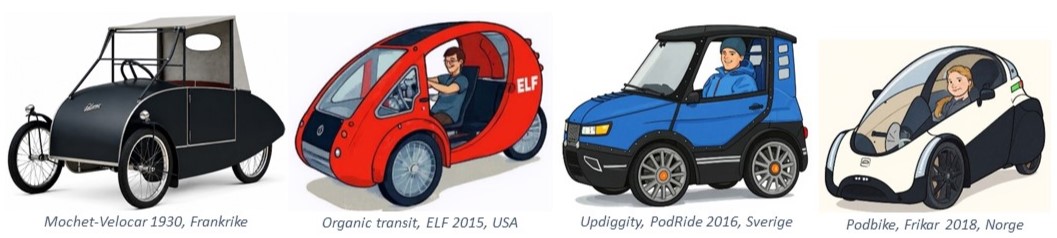
The velomobile, or bicycle car, is an almost unknown vehicle that could make a huge difference for the environment, public health, and road safety. It is safer than a regular bicycle, can be used all year-round on existing roads and cycle paths, and requires neither new technology, nor new
legislation. What is missing is large-scale manufacturing, and with that, lower prices. At this point, a large order could kick-start the entire velomobile industry
What is a velomobile?
A velomobile is a three- or four-wheeled bicycle with a body shell. Legally, it is classified as a pedal cycle and can be driven on both roads and bike paths just like a regular bicycle. The body protects against weather and wind and often provides lower air resistance. With three or four wheels, the velomobile becomes significantly more stable and safer than a two-wheeled bicycle. You usually sit reclined as in a car, with the pedals in front of your body, and have a comfortable seat instead of a saddle.
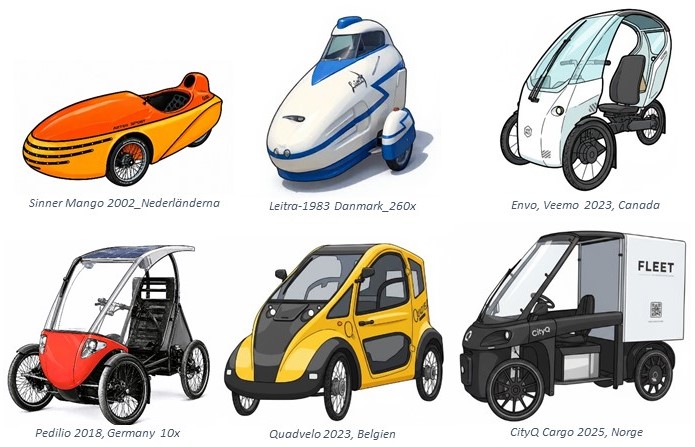
The classic velomobile is low, streamlined, and built for cycling fast and far, but can be quite impractical for everyday use. Many newer models are not nearly as fast, but are instead designed as practical and comfortable commuter vehicles: slightly higher, easier to get in and out of, and almost always equipped with an electric motor. Most velomobiles sold in the EU have a 250 W e-bike motor with a 25 km/h speed limit, but most models also offer motor options to comply with regulations in other countries, and sometimes even moped-class versions.
Why now?
The electric bike has changed the game; thanks to the motor systems and legislation developed for e-bikes, it is now possible to build velomobiles that are much more practical. The velomobile has become a practical everyday vehicle that works for everyone, not just a few enthusiasts as before.
The market is growing rapidly, e-bikes went from a niche to an established product in just fifteen years, and today more than 90,000 e-bikes are sold per year in Sweden alone. Cargo and box bikes, which enjoy the same great advantage of electric assistance as the velomobile, have seen a massive boom and are used today by everyone from families with children to logistics companies.
Climate change is becoming increasingly evident even in Europe: droughts, fires, heatwaves, and floods make the threat more concrete and easier to take seriously. Increased cycling is one of the cheapest ways for a country to reduce emissions and reach its climate goals. Climate goals that today in some cases are EU law with heavy financial penalties.
The potential is vast: In Sweden one in ten already cycles today, but more than half of the population actually lives within cycling distance of work and community services. Around 600,000 Swedes cycle in the summer but put their bikes away in the winter. For this group, the velomobile could be what makes cycling work year-round.
Environmental impact
Small, lightweight vehicles such as velomobiles have a low environmental impact, their lifecycle CO2e emissions per kilometer are estimated to be 30–50%* of those of an electric car. The difference is even greater when it comes to local impacts such as noise, road wear, and particle emissions. Since velomobiles take up less space than regular cars, they also contribute to reduced congestion and a quieter, more pleasant urban environment.
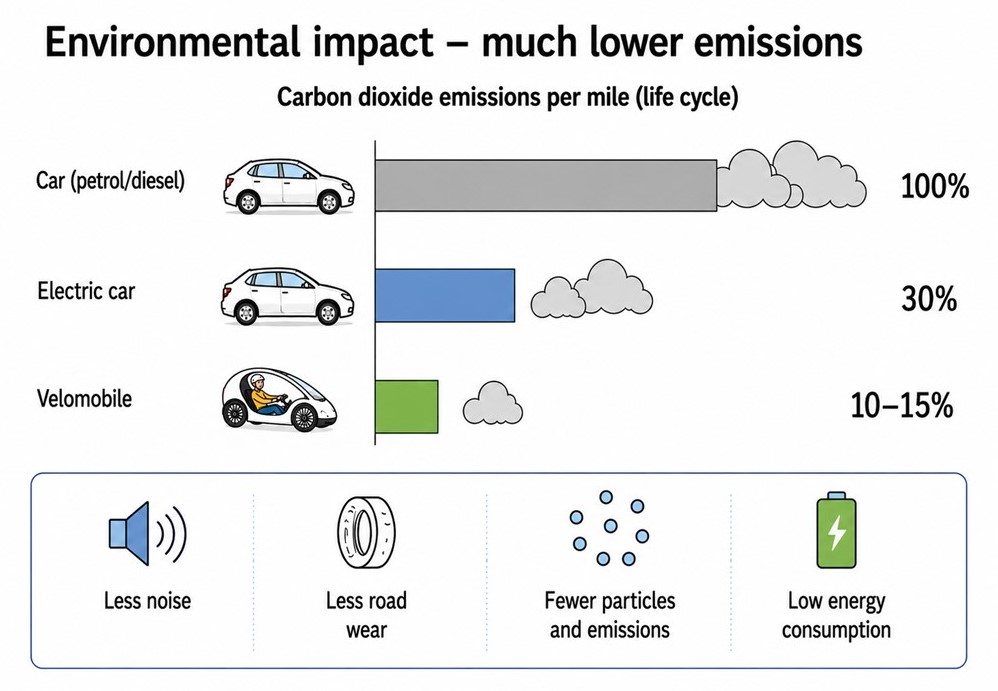
*No reliable measured values for velomobiles were found, so the CO2e figures are estimates based on values for e-bikes and large electric cargo bikes.
Inclusion
Velomobiles are usually classified as a pedal cycle and can be driven on both roads and bike paths like a regular bicycle. You don’t need a driver’s license, good fitness or the ability to keep your balance, so almost anyone can drive a velomobile. In line with current investments in active mobility (walking and cycling), it is becoming increasingly important to find solutions that also work for the elderly and people with various functional variations.
Safety
Velomobiles are generally safer than regular bicycles. This is mainly because they are more stable and have less risk of tipping over and you usually sit lower, which reduces the risk of injury if you still tip over or fall out.
A big study of Swedish bicycle accidents shows that single-vehicle accidents actually account for 80% of all seriously injured cyclists, (1600 people per year). Slippery conditions, curbs, mounting and dismounting, loose and fixed objects, bumps, swerving, etc., cause cyclists to lose their balance and crash. Being struck by cars accounts for 11 percent, and collisions with other bicycles for 8 percent.
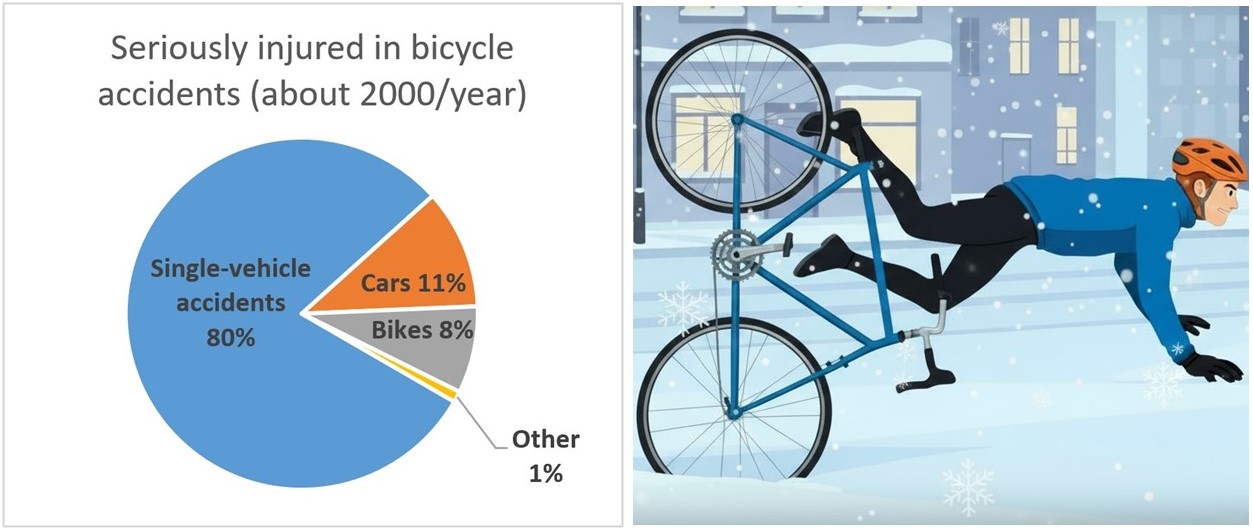
Using a stable three-wheeled or fourwheeled velomobile instead of a twowheeled bicycle would likely be able to significantly reduce serious accidents.
Health
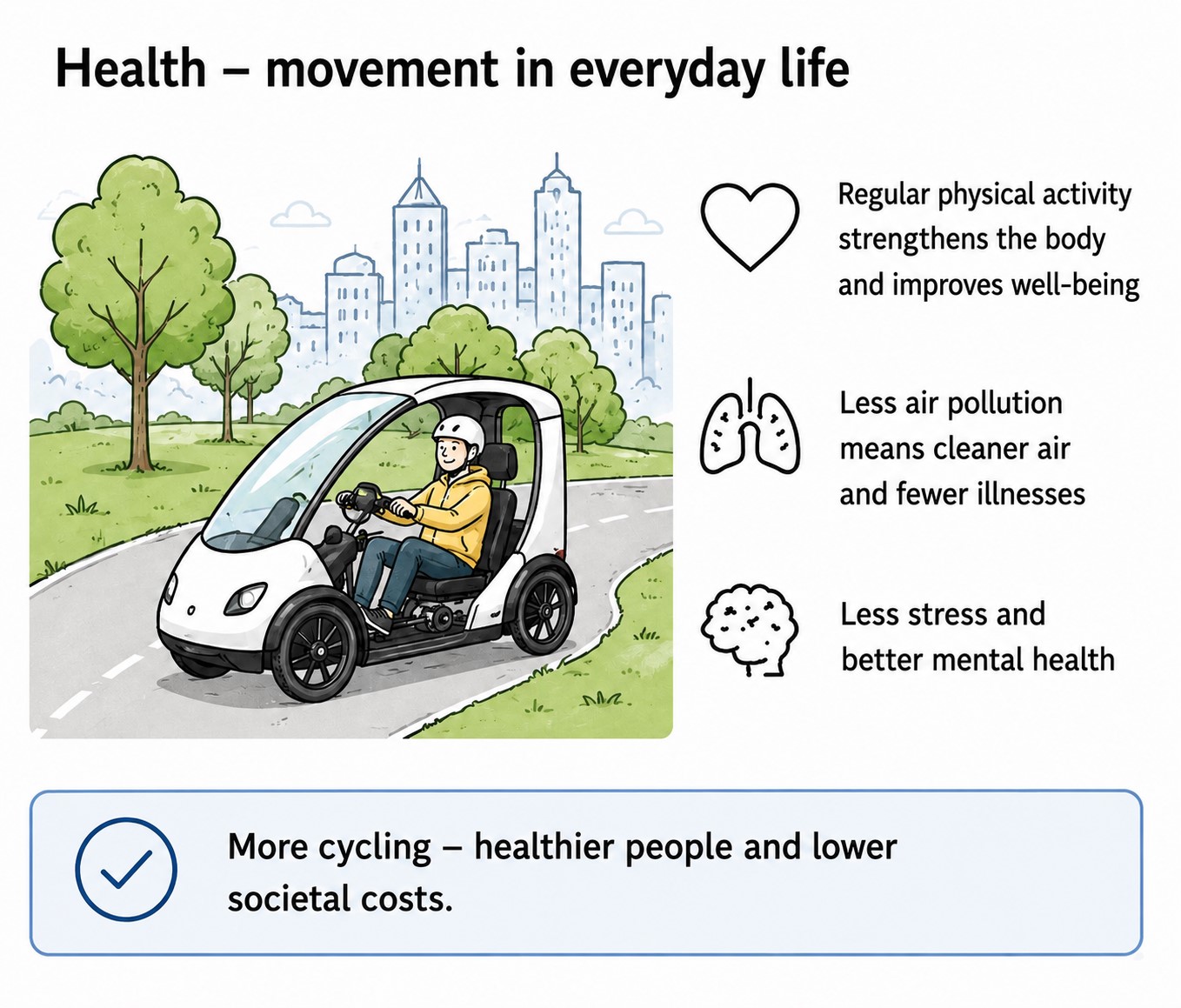
A velomobile is a practical way to incorporate physical activity into everyday life without the need to reduce comfort and safety as much as with regular cycling. It should therefore appeal to a much wider group than regular cycling, and thereby contribute to reducing car driving. Both the exercise itself and reduced particle emissions from traffic provide major health benefits, for both the cyclist and those around them.
Cycling all year round
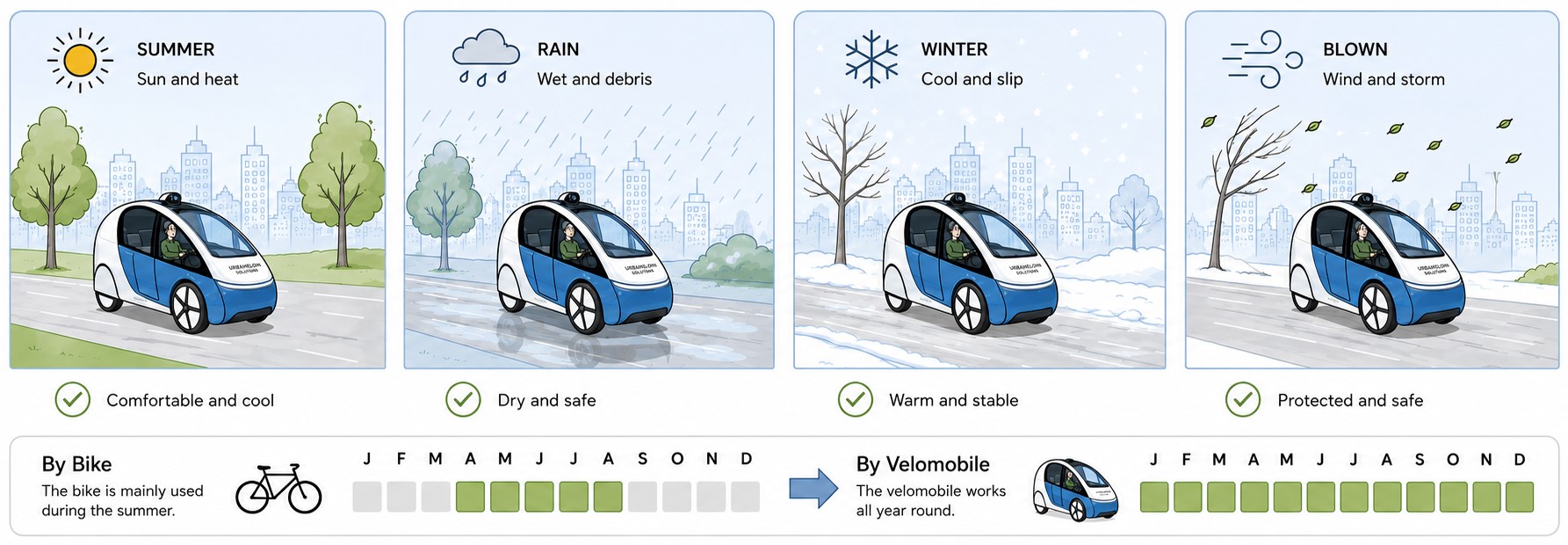
Rain, cold, ice, and wind are some of the most common reasons why people choose not to bike. A velomobile makes it possible to cycle comfortably and safely in almost any weather, making it easier to actually use it as one’s primary mode of transportation.
Price development
The velomobiles that are available for purchase today are expensive, between €7,000 and €15,000, and are manufactured and sold in very small numbers, typically in series of 10–1,000 units. They cannot be purchased from regular bicycle dealers and very few people know they
exist. The high price makes it very difficult to sell them and small-scale production makes them expensive. To reduce the price, you need to produce much larger series. There are very wellestablished rules for how much you can reduce price when increasing the series size in industrial manufacturing (Wright’s Law, Learning Curve and Economies of Scale).
For this product category, you can usually calculate a price reduction of between 10-20% for each time you double production. If we assume 15%, the price will be almost half at 16,000 units, and almost one third at 128,000 units.
| Production volume | Factor | App. Price |
|---|---|---|
| 1,000 units, today’s small-scale manufacturing | 1,00 | €7,500 – €15,000 |
| 2,000 units | 0,85 | €6,400 – €12,700 |
| 4,000 units | 0,72 | €5,400 – €10,800 |
| 8,000 units | 0,61 | €4,600 – €9,200 |
| 16,000 units, comparable to bicycle /motorcycle series | 0,52 | €3,900 – €7,900 |
| 32,000 units | 0,44 | €3,300 – €6,600 |
| 64,000 units | 0,38 | €2,800 – €5,600 |
| 128,000 units, comparable to car/moped series | 0,32 | €2,400 – €4,800 |
The price drops more than many think with increased production volume.
Operating cost
Velomobiles are cheap to run, much like a high-end e-bike. The charging cost is only a few cents per kilometer, so the major costs are the wear and tear on batteries, tires, and servicing, landing around €0.10 per km. But to get a fair picture, one also needs to include depreciation.
| Operating cost | Purchase | Life | Depreciation | Total cost |
|---|---|---|---|---|
| Small-scale velomobiles | €15,000 | 50,000 km | €0.30 / km | €0.40 / km |
| In mass production | €4,800 | 50,000 km | €0.10 / km | €0.20 / km |
With today’s prices, a velomobile ends up being roughly as expensive per kilometer as an electric car, meaning there are no financial savings today; rather, one needs to be interested in the other benefits such as safety, health, and the environment.
With mass-produced velomobiles, the cost would be less than half the cost per kilometer compared to an electric car, making it an excellent choice from a financial perspective as well.
Socioeconomic benefits
Socio-economically, the potential benefits are very large. Improved public health is difficult to put an exact figure on, but fewer sick days and more people working is universally positive for the economy. Bicycle accidents are estimated to cost Swedish society around €670 million per year (based on approximately 2,000 serious accidents at €335,000 each). More cyclists in safer vehicles could thus yield significant savings purely financially.
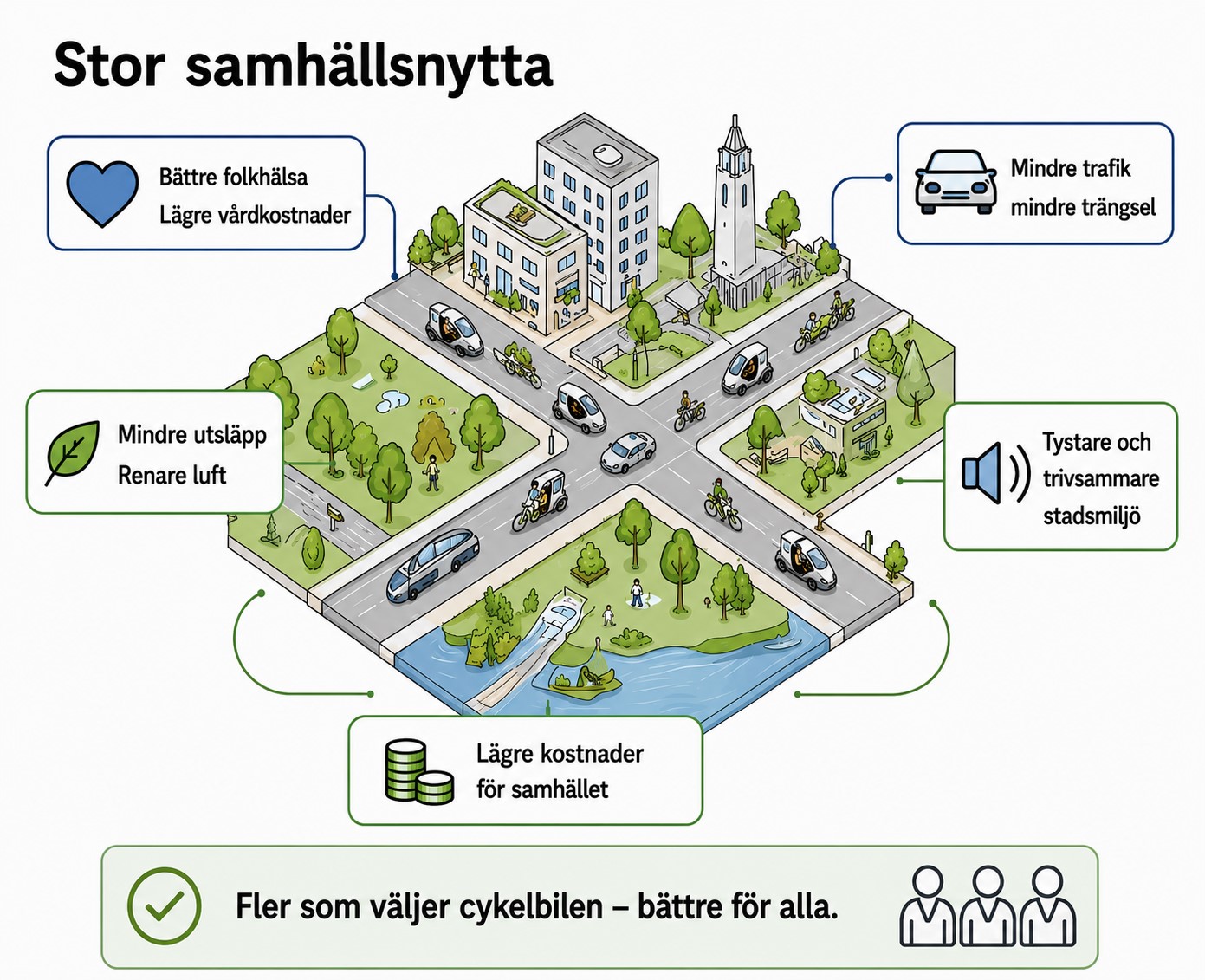
Bike paths are generally cheaper to build and maintain than roads and infrastructure for passenger cars. More people able to get around on their own should reduce the need for subsidized public transport and specialized transport services.
Disadvantages
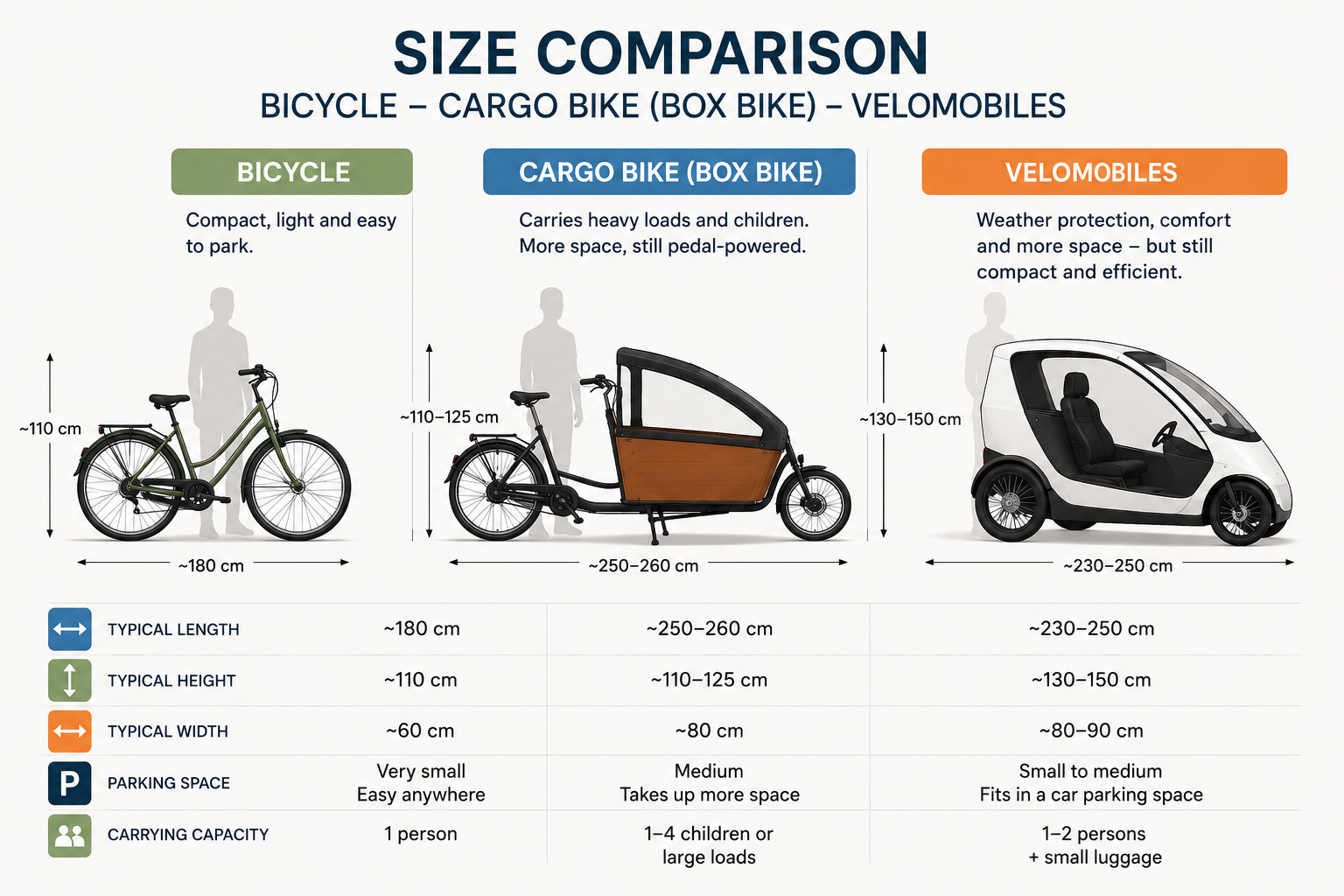
Velomobiles are heavier and larger than regular two-wheeled bicycles, which makes them more difficult to transport and requires more space for parking. The extra weight also makes them more dependent on the electric motor, many models are quite heavy to pedal without electric assistance. To go up steep hills, you need a more powerful and often more expensive motor than for a regular two-wheeled electric bicycle.
These are largely the same challenges that electrically assisted box and cargo bikes face today and are quite manageable disadvantages.
The velomobile cannot replace the car when it comes to longer and faster journeys, more passengers, larger and heavier loads, etc. So most people will still want access to a passenger car in some way. A large family in the countryside will still need their two cars, and a family in a city will probably want to keep one passenger car even if they acquire velomobiles. Small households in a city might get by just fine with a velomobile but will probably want to borrow or rent a passenger car occasionally (car-sharing pool or kind parents).
The velomobile does not replace the car, but it has great potential to reduce the number of cars and above all, reduce car driving in our cities.
Why no one dares to manufacture Velomobiles
A velomobile is a relatively complicated product and is expensive to manufacture in small numbers. In small-scale manual manufacturing, the start-up cost is quite small, but the cost of parts and labor is very high. In industrial manufacturing, you need to invest in manufacturing tools such as molds, press tools, and a production line, resulting in a very high start-up cost. In small series, the start-up cost is spread over too few units, so even if the manufacturing cost itself has decreased, the unit price is still very high. This makes it very difficult to prove the market for the product with a small business, the price is simply too high for it to sell well. And without proven sales, no investors dare to invest in the large-scale manufacturing that would bring the price down, a classic catch-22.
How to solve a catch-22
Subsidized market test: One way to get a good test would be to simply subsidize the price of a small series so it matches the price of large-scale manufacturing; then you get a real test of the market and the product without spending an enormous amount of money. It would be very interesting to see such a test for a good velomobile, but it naturally requires a major investor who believes enough in a velomobile to take on that cost.
Ordering the future: Large buyers can control what is actually developed and manufactured, something that is often underestimated. It is rarely what is in the buyer’s best interest or what is technically possible that determines which products are available. Rather, it is what is most profitable for the manufacturer at the moment!
A large enough buyer can commit to purchasing a new product in advance, and have the manufacturer develop and manufacture exactly the product the buyer needs.
The velomobile and other socially beneficial products can be developed in this way. If you gather large buyers such as municipalities, companies and cities in joint orders, you can
get the volumes required to produce new, better products at a good price. Capable buyers can do more for the sustainable transition than any other group in society.
The best scenario for the velomobile would be to get municipalities and cities involved. Partly because they are large organizations but also because they are the ones who manage and plan the traffic environment in which the velomobile will be used.
Example: Ten major European cities join forces and commit to renting or leasing a thousand velomobiles each to their employees (company velomobiles, shared velomobile pools and commuter benefit schemes).
10,000 units provide good conditions for industrial manufacturing and cities get to test a new product that can help them achieve their environmental goals and have healthier employees.
Summary
The velomobile fills the gap between the bicycle and the car. It is a safe, cheap, and environmentally friendly way to get around in daily life, and it can become a key player in the
transition to a more sustainable transport system. Just as the e-bike and the cargo bike have already done, the velomobile has good prospects to move from a niche product to a mass
market. And it doesn’t need new technology, big infrastructure investments, or new legislation.
The only thing missing is large-scale manufacturing, so that the price can come down.
Closing words
I have 20 years of experience developing and promoting velomobiles and have developed two velomobiles of my own (PodRide and Dtrike), so this is not an independent report. The text is based on official statistics and reports, but I have also made some reasonable assumptions. I have tried to remain neutral toward different manufacturers and models since I want to promote the entire velomobile industry.
The purpose of the document is to try to highlight the velomobile and make the public and decision-makers aware of its existence and benefits.
If this sounds interesting or if you would like to help, please get in touch.
Mikael Kjellman, Frösön 2026-09-11
Downloadable PDF